
Criminal Cases in King and Queen County Courts
King and Queen County criminal cases divide among three Virginia courts. General District Court, often called GDC, tries misdemeanors and traffic charges and conducts preliminary hearings in felony cases. A preliminary hearing tests whether there is enough cause to send a felony forward. Circuit Court tries felonies, hears appeals from district court, and keeps the later felony case file. Juvenile and Domestic Relations District Court, or J&DR, hears juvenile matters and certain adult cases tied to family or household issues. Juvenile files are confidential, but public information about qualifying adult criminal matters may appear in the state search.
Each clerk keeps that court's docket, pleadings, and orders. This county has no municipal court or city clerk. The King and Queen GDC page confirms the lower court's role, while the Circuit Court page identifies the felony-level clerk. Search both courts when tracing a felony from its first hearing through trial.
King and Queen County Felony Files
The Circuit Court Clerk keeps felony trial records at 234 Allen's Circle, P.O. Box 67, King and Queen Court House, VA 23085-0067. Call 804-785-5984 during the listed 8:30 a.m. to 4:30 p.m. hours. This is a different counter from GDC at 242 Allens Circle. Ask Circuit for older files, signed orders, appeals, sealing filings, and certified copies missing online.
The official King and Queen Circuit Court source shows the clerk contact and court terms.
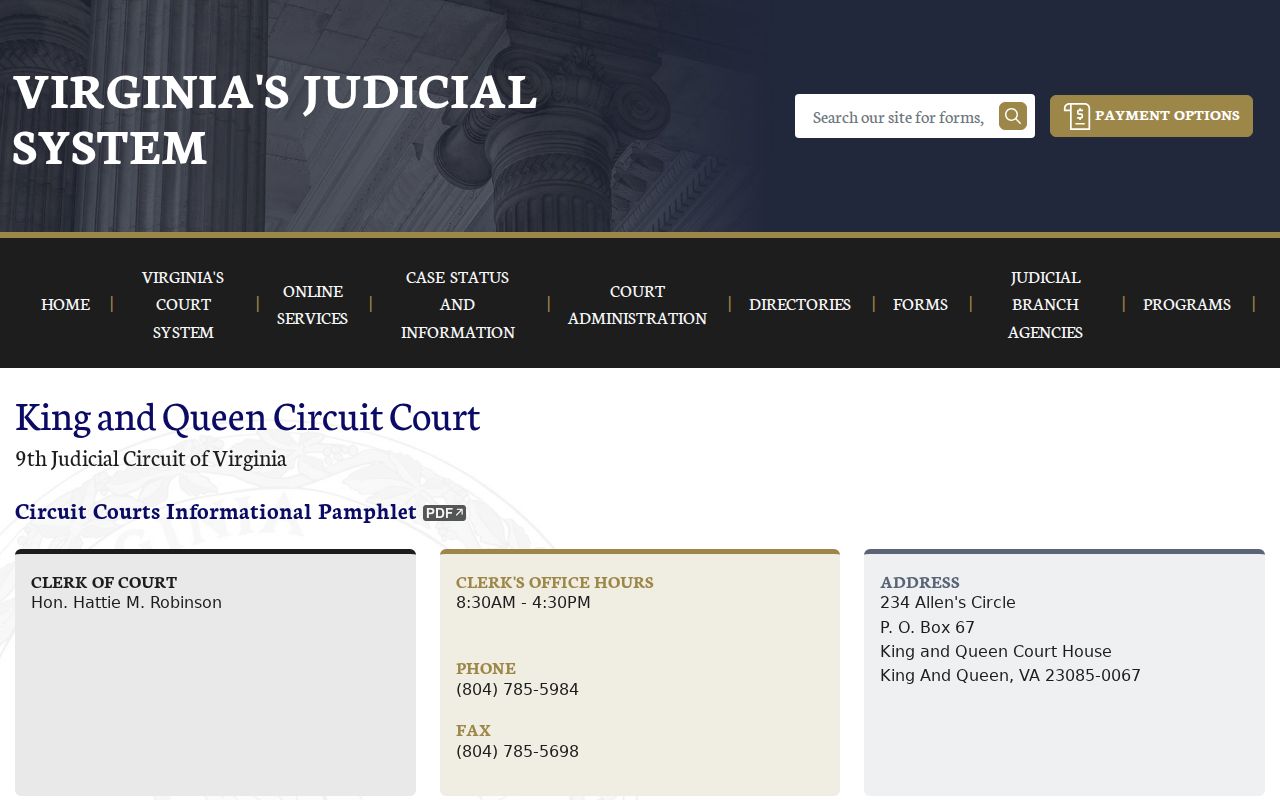
The listing points to the felony docket and order custodian. Circuit terms start on the second Tuesday of even-numbered months, with the grand jury on the first day.
King and Queen Circuit Clerk
234 Allen's Circle
P.O. Box 67
King and Queen Court House, VA 23085-0067
804-785-5984
8:30 a.m. to 4:30 p.m.
King and Queen GDC Clerk
242 Allens Circle, Suite F
P.O. Box 86
King and Queen Court House, VA 23085
804-785-5982
8:30 a.m. to 4:30 p.m.
How to Search Case Records
Begin with the Virginia Judiciary Online Case Information System-Statewide Search, OCIS 2.0. It accepts a defendant name or case number and covers GDC criminal and traffic cases, adult criminal J&DR matters, and select Circuit Courts. It is not a full Circuit archive. For a focused King and Queen County search, also use the GDC locality system and its Name, Case Number, or Hearing Date tab.
- Open OCIS 2.0 and accept its terms, then try the defendant-name or exact case-number route.
- Open the district-court search and select King and Queen General District Court before choosing a tab.
- Enter the name as it appears on the summons or warrant, or use the exact case number or known hearing date.
- Read the court, charge, hearing, and status fields as an index. Do not treat the screen as the signed final order.
- Call or write the named clerk for the docket, pleadings, orders, plain copies, or certified copies.
District updates generally post by 6:00 a.m. the next day. Public birth dates are protected. Use a current Chrome, Edge, Firefox, or Safari browser.
| Field Label | Type | Required | Notes |
|---|---|---|---|
| Court | Dropdown | Unspecified | Select King and Queen General District Court |
| Search tab | Tabs | One mode | Name, Case Number, or Hearing Date |
| Last / First / Middle Name | Text | Middle optional | Use the spelling on the case papers |
| Case Number | Text | Mode-specific | Use the exact case-number route |
| Hearing Date | Date | Mode-specific | Search by the known court date |
The official district search instructions show these tabs and controls.
The screen separates finding a case from paying an eligible charge. Research first, then contact the clerk when the needed document is not displayed.
King and Queen County Search Limits
An online hit is an index, not the whole King and Queen County case file. OCIS may show the court, case number, charge, hearing, and status. Its select Circuit coverage means a missing result cannot prove that no felony file exists. The GDC system is narrower and excludes confidential juvenile matters. If a result is absent, check spelling and case number, then call GDC for lower-court files or Circuit for felony trials and appeals.
The OCIS 2.0 landing page is the statewide starting point.
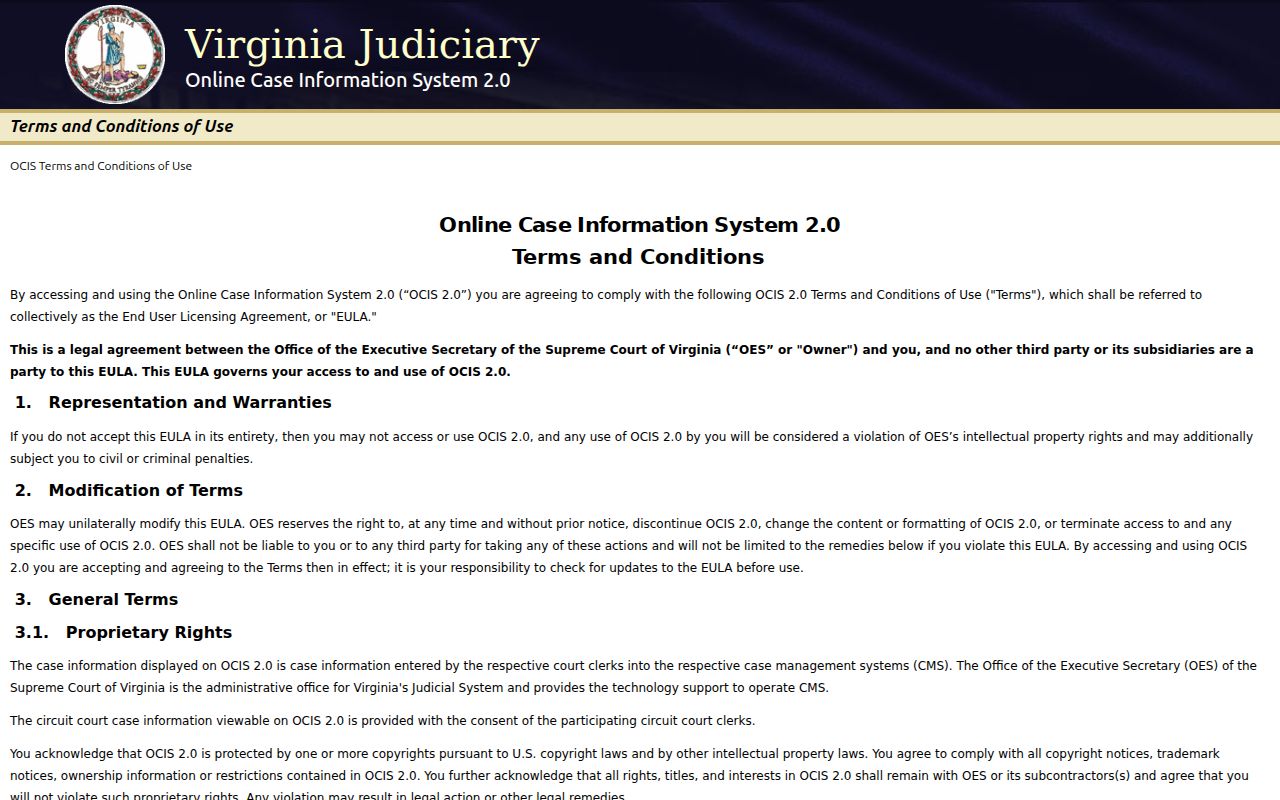
This statewide layer locates adult case entries. The correct King and Queen clerk remains the source for a filed document or certified judgment.
Note: Judicial case files follow court-record law and rules, so sending a felony-order request to county administration can delay the search.
What the Case File Shows
A King and Queen County case file ties each charge to the court's work on it. The docket is the time-ordered log of hearings and filings. Pleadings show what a party asked the court to do, and orders show what the judge decided. The sentencing order is the strongest local source for a conviction and sentence. A booking charge or a payment balance cannot take its place. Public views may omit a protected birth date, Social Security number, victim or minor identity, medical information, or sealed content.
| Case Number & Court | Identifies the file and the clerk responsible for it. |
|---|---|
| Charging Document | States the alleged offense, statute, and charge class as filed. |
| Docket Entries | Lists hearings, filings, orders, and other case activity by date. |
| Hearing Dates | Shows scheduled and completed court events. |
| Disposition & Judgment | Records whether a charge is pending, dismissed, acquitted, or resolved by conviction. |
| Sentence & Conditions | May state confinement, probation, fines, costs, restitution, and related orders. |
Financial terms need care. A fine is punishment, costs are court charges, restitution repays a loss, and bond secures release and appearance. An online balance alone does not state the outcome. Request the docket and signed order when the exact result matters.
King and Queen County Criminal Docket
King and Queen GDC schedules court on the first through fourth Fridays. Arraignments are listed at 9:00 a.m., Sheriff traffic at 9:30 a.m. and 1:00 p.m., Virginia State Police traffic at 10:00 and 10:30 a.m., and criminal trials at 11:00 a.m. Court is not held on the fourth Friday in November or December. Those blocks can hint at the enforcing agency or type of event, but the actual case entry and charging paper must confirm both.
The official King and Queen General District Court schedule also sets courthouse rules.
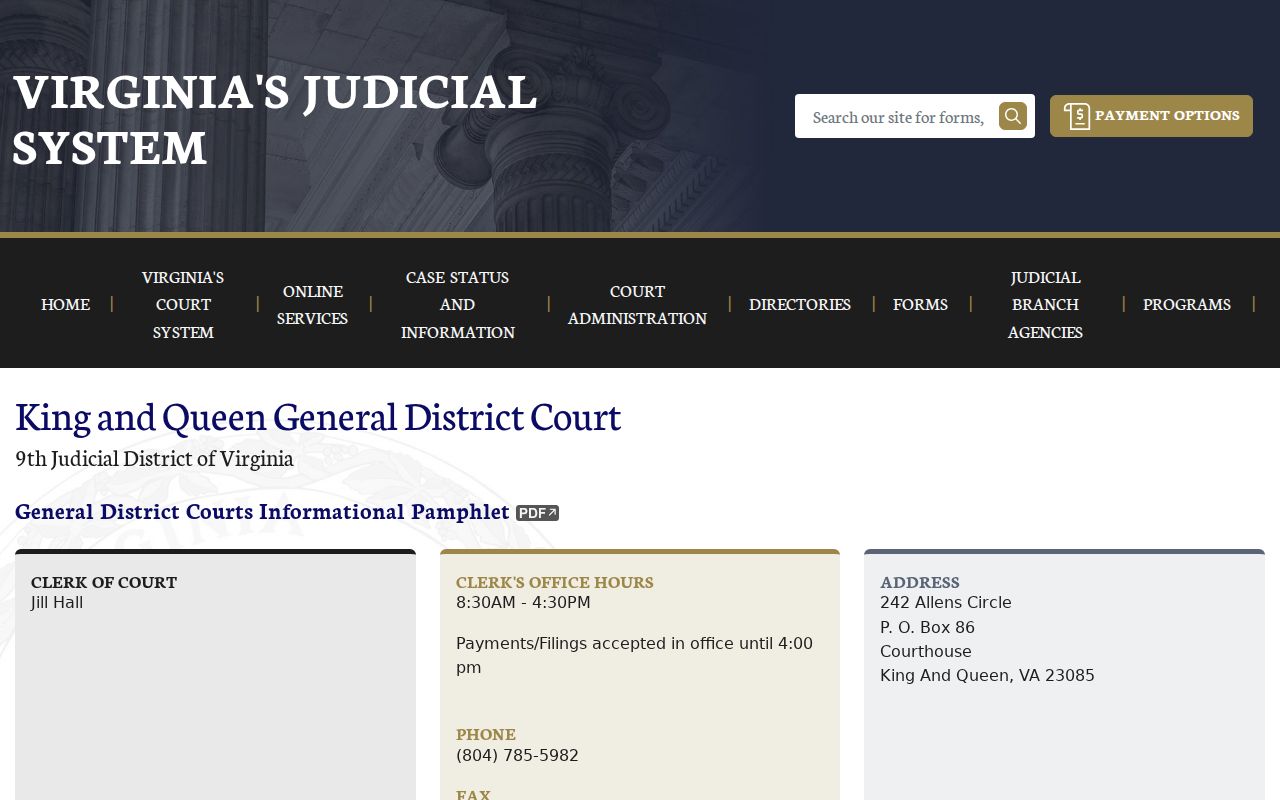
This local calendar places arraignments before trial blocks. It does not predict how long one case will last or promise that every listed matter will proceed that day.
All visitors are subject to search. Weapons, outside food and drink, phones and other electronics without judicial permission, purses, and bags are barred. Call before bringing a device to inspect King and Queen County court records.
Stages of a Criminal Case
A criminal case can begin with an arrest or summons, followed by a magistrate's warrant and an initial appearance. A misdemeanor may stay in GDC through trial. A felony usually has a GDC complaint and preliminary hearing before a grand jury considers an indictment. If indicted, the felony moves to Circuit Court for arraignment, pretrial motions, a plea or trial, disposition, and sentencing. An appeal can create the next layer of records.
Case flow: Charges Filed › Arraignment › Pretrial › Plea or Trial › Disposition › Sentencing
The stages explain why one search may show more than one case number or court. They also show why an arrest entry is not the final answer. For broader context on the difference between intake charges and a court result, see the county's arrest history records.
Note: A GDC criminal appeal must be noted within ten calendar days, so contact the clerk promptly when reviewing your own case deadline.
Reading King and Queen County Case Outcomes
A case status should be read charge by charge. “Pending” means the court has not recorded a final result. “Dismissed” ends the charge without a conviction. “Acquitted” means a not-guilty result. “Convicted” records guilt. “Nolle prosequi,” often shortened to nolle, means the Commonwealth ended prosecution without a judgment of guilt. A deferred disposition delays the final outcome while stated conditions are completed and can sometimes lead to dismissal.
- Disposition
- The final recorded outcome of one charge.
- Docket
- The chronological record of court activity.
- Indictment
- A grand jury's formal felony accusation.
- Restitution
- Payment ordered to make up for a victim's loss.
- Capias
- Court process that commands an arrest.
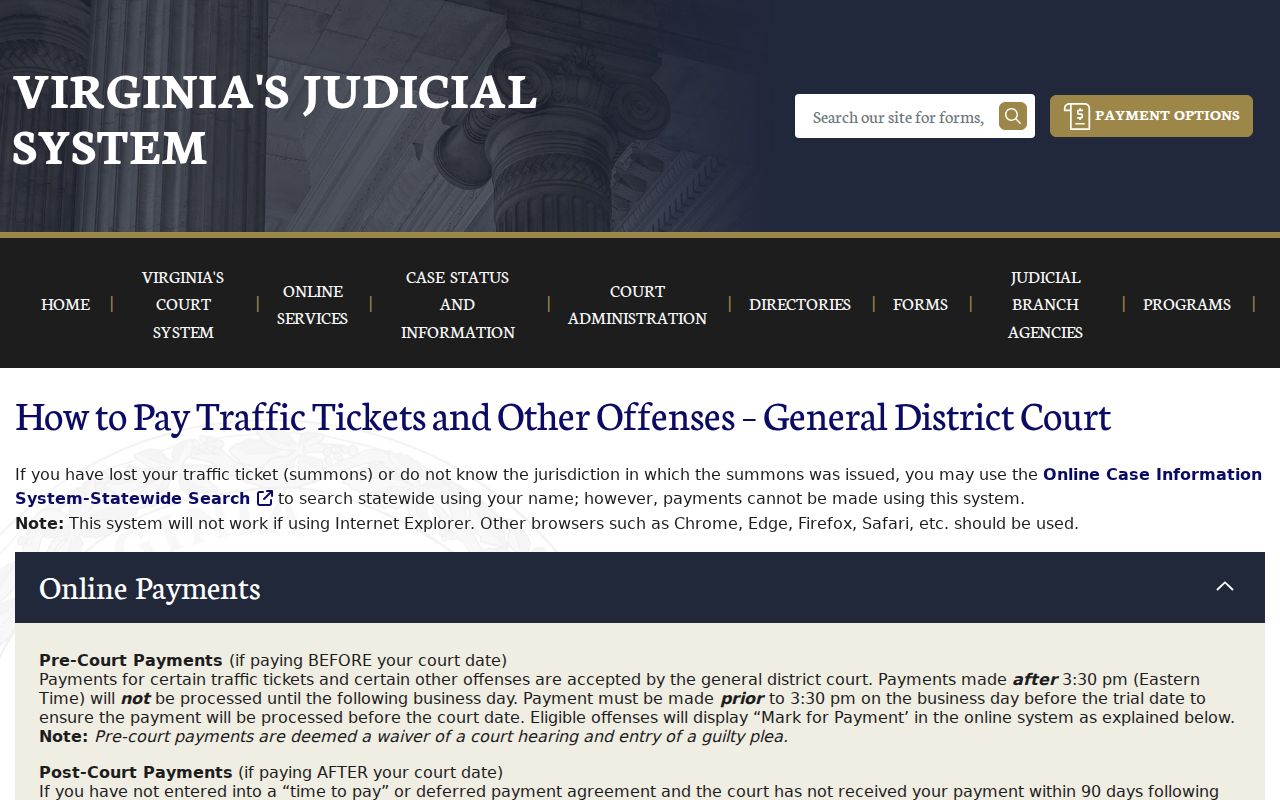
Do not infer the result from a payment button. The district payment system accepts only eligible items, adds a 4 percent convenience fee, and labels its control “Mark for Payment.” Paying a prepayable matter by 3:30 p.m. on the business day before court waives the hearing and is treated as a guilty plea. That tool should not be clicked just to inspect King and Queen County case records.
King and Queen County Juvenile Records
J&DR is a third route for certain King and Queen County criminal matters. Its main clerk is at 351 Courthouse Lane, Suite 206, King William, VA 23086, phone 804-769-4946. The limited counter at 242 Allens Circle opens on first and third Mondays, second and fourth Wednesdays, and third Tuesdays from 8:30 a.m. to 4:30 p.m. It accepts only credit cards and uses 804-769-5071 on those days.
The official J&DR court source documents the shared-office schedule.
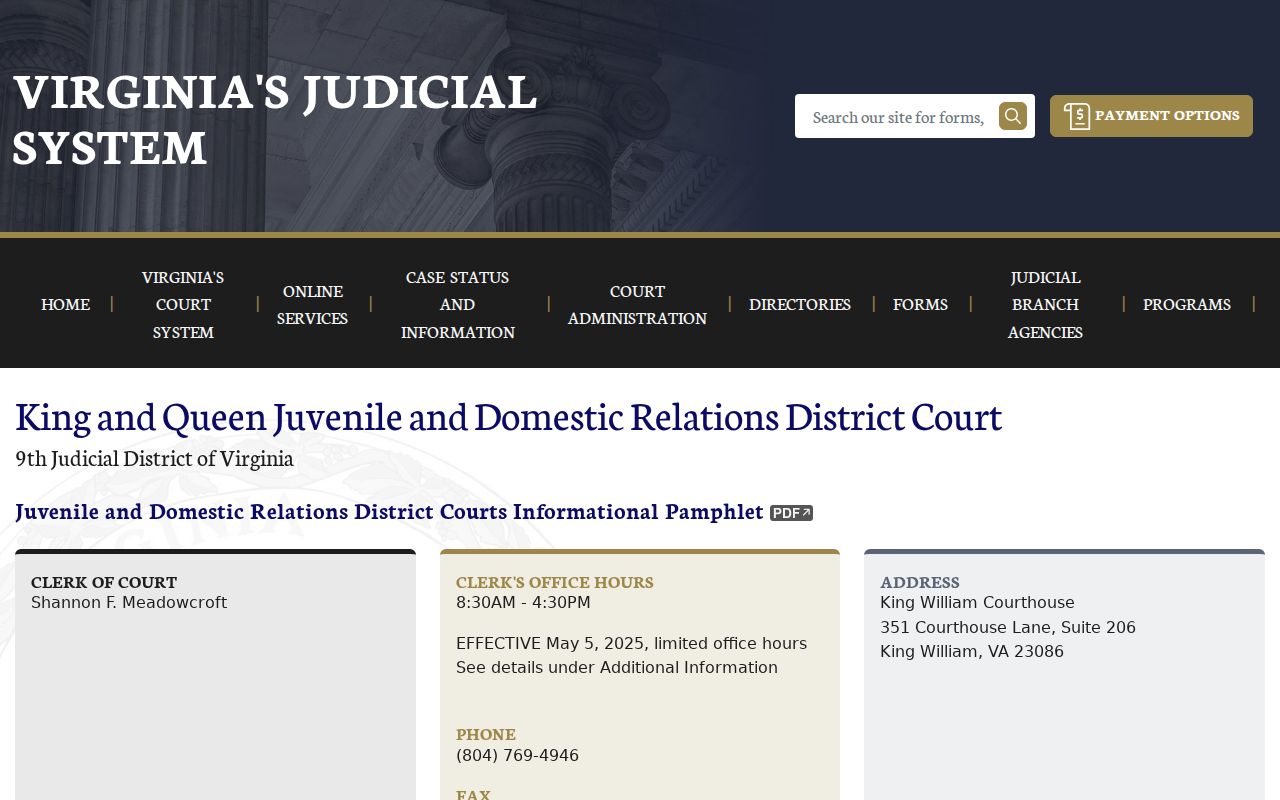
This schedule matters for authorized requests about adult matters. It does not open juvenile case files to public view. Juvenile case details remain confidential and absent from the public case lookup, so a blank search result can reflect a legal access limit rather than a missing record.
Access & Restrictions
Virginia Code § 17.1-208 allows inspection and copies of nonconfidential Circuit clerk records for reasonable charges. Ask for the exact docket, pleading, order, or certification needed. Local copy fees were not found, so request the price first. The Virginia Freedom of Information Act governs many agency records, but clerk-held case files follow court-record law and rules. County administration is not their custodian.
Access does not mean every field is public. Juvenile records, victim and minor identities, Social Security numbers, medical details, protected addresses, sealed warrants, and sealed or expunged cases can be withheld or redacted. An online summary may show less than the public paper file, yet the clerk still cannot release confidential content. Describe the record by court, case number, charge, and approximate date when possible. If part is withheld, ask which rule or statute controls the restriction.
The Virginia criminal sealing forms index reflects the state's newer sealing process.
Sealing restricts ordinary public access, but it is not the same as destroying every record. When a King and Queen County case no longer appears, the clerk can distinguish a sealed matter from a search-coverage problem when law permits a response.