
How to Check Criminal History in King and Queen County
Start with the public system that best fits the event. The Virginia Judiciary Online Case Information System-Statewide Search, or OCIS 2.0, indexes adult criminal matters in General District Court, adult criminal matters in Juvenile and Domestic Relations District Court, and select Circuit Court records. It is useful for finding a court and case number, but it is not a full archive of every King and Queen County felony file. A missing result does not clear a person or prove that no record exists.
| Field or Control | Type | Required | Use |
|---|---|---|---|
| Court | Dropdown | Unspecified | Select King and Queen General District Court |
| Search tab | Tabs | One mode | Name, Case Number, or Hearing Date |
| Last Name | Text | Unspecified | Use the spelling on the case paper |
| First Name | Text | Unspecified | Use the legal or case spelling |
| Middle Name | Text | Optional | Enter it when it appears on the record |
| Case Number | Text | Mode-specific | Exact case-number route |
| Hearing Date | Date | Mode-specific | Date-based route |
| Search | Button | Not applicable | Runs the selected query |
The official county home page shows the local government structure. The King and Queen County government page supplies the accompanying image.
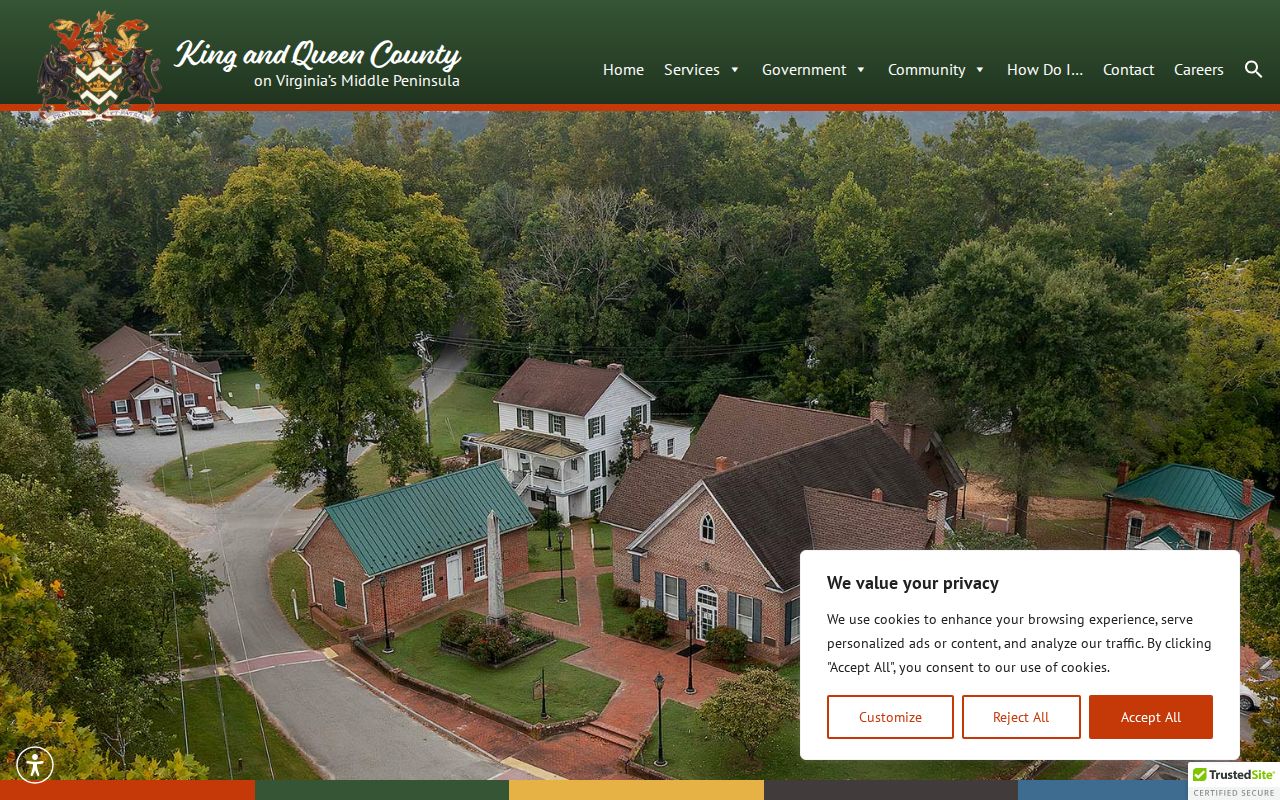
That page routes users to the separately elected constitutional offices that hold much of the county's criminal record material.
- Search OCIS 2.0 by defendant name or case number, then note the court and case number.
- Use the King and Queen General District Court locality search for name, case-number, or hearing-date detail.
- Call the General District clerk for misdemeanor and felony preliminary files, or the Circuit clerk for felony trials and appeals.
- Check Middle Peninsula Regional Security Center for current custody, then call if its embedded list fails.
- Request the arrest narrative from the sheriff or other arresting agency instead of asking the court for a police report.
- Use the notarized SP-167 process when the consenting subject needs a compiled Virginia history.
For a possible active warrant, call the sheriff and the clerk that may have issued the process. Online silence is not warrant clearance.
Three King and Queen County Record Offices
An arrest, a jail intake, and a prosecution create different files. The King and Queen County Sheriff's Office or Virginia State Police writes the incident and arrest report. Middle Peninsula Regional Security Center creates the booking and custody record. A court clerk creates the docket, orders, plea, disposition, and sentence. Asking one office for all three can lead to an incomplete answer because no local office owns the whole chain.
- Arrest or incident report
- Start with the creating law-enforcement agency for the officer narrative and alleged event.
- Booking or custody file
- Start with MPRSC for intake, bond, location, and release data when public.
- Criminal case file
- Start with the GDC or Circuit clerk for filed charges, hearings, orders, and the final outcome.
The official King and Queen County directory shows how those offices are split. Its directory view appears in the accompanying capture.
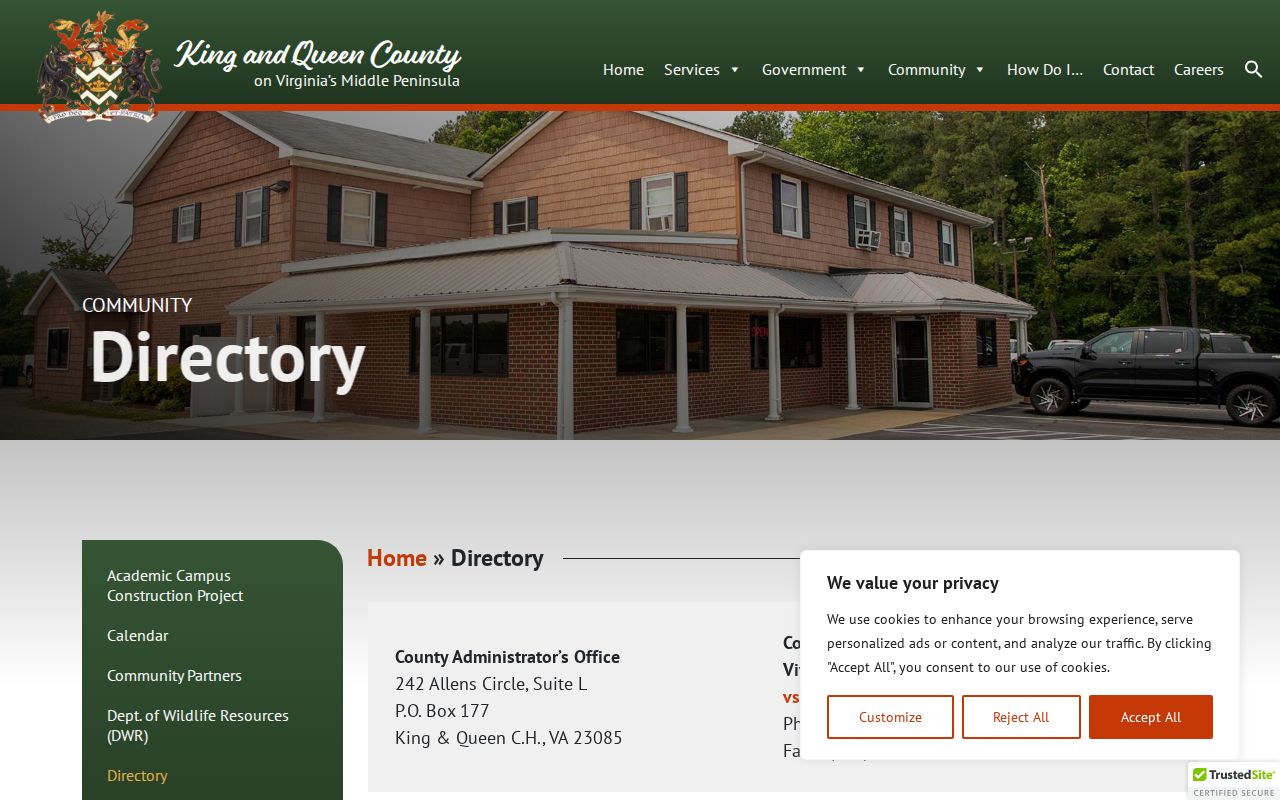
The directory is more reliable than treating the county administration desk as a central criminal records counter.
Note: Name the exact record sought, since an office need not create a new criminal-history summary in response to a records request.
Official Virginia Background Checks
The Virginia Department of State Police Criminal Justice Information Services Division operates the Central Criminal Records Exchange, Virginia's sole criminal-history repository. A member of the public may request what VSP describes as a complete Virginia history through SP-167. The subject must consent and sign before a notary. If the result goes to another requester, that recipient also completes and notarizes the second authorization. One form is used for each subject.
SP-167 is not an instant anonymous name search. The form goes to VSP CARE at 7700 Midlothian Turnpike, North Chesterfield, Virginia 23235. Normal processing is about 15 business days after receipt, with no expedited service. Current official materials discuss $15 and $20 checks without a clear option-to-price map, so confirm the fee before payment. Remote online notarization can be added for $25. A headquarters drop-off still joins the regular processing queue.
Fieldprint handles authorized checks that Virginia law requires to be fingerprint-based. It is not an unrestricted walk-in search for personal curiosity. For an identity challenge, VSP can use fingerprints to test whether a CCRE entry belongs to the right person. The agency that supplied a wrong arrest or disposition must correct the substance of that event.
King and Queen County SP-167 Checks
A name-based response is not the same as fingerprint identification. Similar names can collide, and a no-hit result is not a claim that no arrest record exists anywhere. SP-167 covers Virginia information compiled by CCRE, not a nationwide FBI history. Readers reviewing their own federal identity history must use the FBI's subject-only process.
| Item | Known amount or rule |
|---|---|
| SP-167 base check | Official materials refer to $15 and $20; confirm the current selection |
| Remote online notary | $25 add-on |
| VSP fingerprint card | $10 first card; $5 each additional card |
| Authorized Virginia and FBI search | $27 before vendor charges |
| FBI subject-only summary | $18 |
Use the court and agency routes for quick local questions. SP-167 processing is too slow for current custody, a near court date, or urgent warrant status.
Types of Criminal Records
Each criminal record answers a narrow question. A report describes what an officer recorded. A booking file documents intake and custody. A court file shows what the Commonwealth charged and what the judge or jury did. A rap sheet joins reportable arrest and disposition cycles at the state level. Warrants, supervision files, and registry entries have their own custodians and access limits.
- Arrest and incident reports: held by the sheriff, VSP, or another creating agency and subject to investigative redactions.
- Booking records: held by MPRSC for local and pretrial custody, not final guilt.
- Court files: held by General District, Circuit, or J&DR clerks according to jurisdiction.
- CCRE histories: compiled by VSP from reportable arrests and court dispositions.
- Supervision records: held by VADOC Gloucester District 5 for felony probation and parole.
- Registry information: managed statewide by VSP for public safety purposes; use the official routes described in the King and Queen County sex offender check.
Virginia divides crimes into six felony classes and four misdemeanor classes. Circuit Court tries felonies, while General District Court tries misdemeanors and conducts felony preliminary proceedings. Class 5 and Class 6 felonies can carry either penitentiary or local-jail ranges, but that sentencing choice does not change the recorded statutory class. The Commonwealth's Attorney prosecutes qualifying charges but does not replace the clerk as the source for the case file. Federal criminal cases are a distinct record type. The Richmond Division of the Eastern District of Virginia serves King and Queen County, and the official Richmond federal courthouse page supplies this source capture.
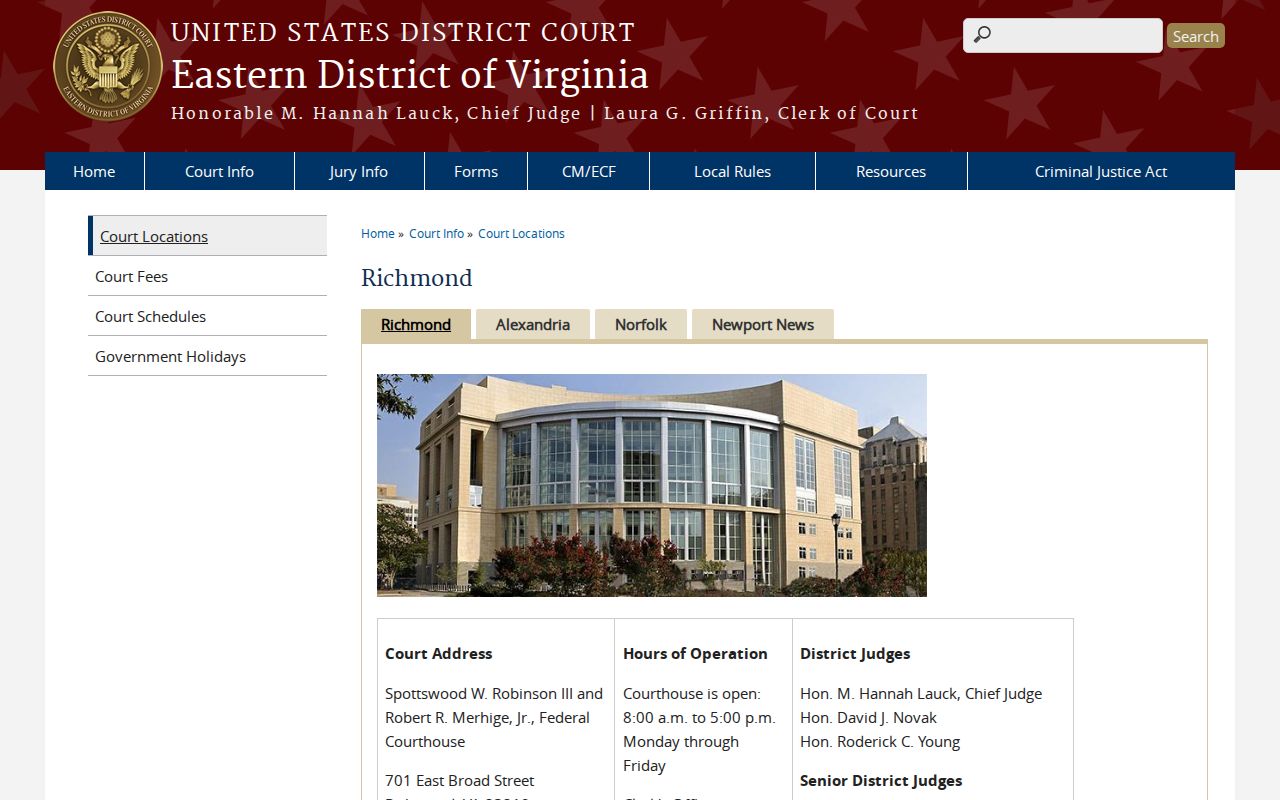
PACER and the federal clerk hold those case records. County court portals do not cover the federal docket.
Note: The offense class identifies the statutory category, while the judgment and sentence state what the court actually decided.
King and Queen County Jail Records
King and Queen County does not operate a stand-alone county jail roster. It belongs to Middle Peninsula Regional Security Center with Essex, King William, Middlesex, and Mathews. The jail is at 170 Oakes Landing Road in Saluda and has a rated capacity of 121. Its official current-inmate wrapper can fail because it embeds an insecure IP-based list. When it does, call 804-758-2338 rather than treating the blank view as proof of release.
The official MPRSC home page identifies the regional facility and its member counties. The full King and Queen County arrest history explains how the current listing, phone line, and jail-record request work together.
For older booking data, request a defined custody episode from MPRSC by mail, fax, email, phone, or in person. VADOC's Inmate and Supervisee Locator is the better route for a sentenced state prisoner or a person under state felony supervision. VINELink supplies custody notifications, but an alert is not a certified court outcome.
What a King and Queen County Criminal Record Shows
The fields depend on the custodian. CCRE may hold names, aliases, physical identifiers, fingerprint-supported arrest cycles, charges, court outcomes, sentences, and supervision events. A clerk file may show the case number, filed charge, hearing dates, counsel, plea, disposition, orders, fine, costs, restitution, bond, and docket activity. A jail file can show intake data but may not show the final court result.
| Name and identifiers | Legal name, aliases, and agency identifiers used to match a record |
|---|---|
| Arrest and booking | Agency, date, intake charge, booking number, bond, location, and release where public |
| Charges and statutes | Alleged or filed offense, code section, and class |
| Disposition | Pending, dismissed, nolle prosequi, acquitted, or convicted outcome |
| Sentence | Custody, suspended time, probation, fine, costs, and restitution as ordered |
| Custody or supervision | Jail, prison, probation, or parole status within the relevant system |
Public displays may suppress dates of birth, Social Security numbers, juvenile and victim identities, health data, and investigative details. A search screen is an index, not always the signed final order.
King and Queen County Court Counters
The courthouse complex has two street-number forms that matter. King and Queen General District Court is in Suite F at 242 Allens Circle. It handles misdemeanor trials and felony preliminary matters. The Circuit clerk is listed separately at 234 Allen's Circle and holds felony trial files, district appeals, archived matters, and expungement or sealing filings. Mailing a request to the wrong constitutional office can slow the search.
The official Commonwealth's Attorney page shows the prosecutor's Suite G office in the same government complex.

That office prosecutes qualifying charges and handles criminal continuance approval in GDC, while the clerks maintain the court records.
King and Queen Circuit Court
234 Allen's Circle, P.O. Box 67
King and Queen Court House, VA 23085-0067
804-785-5984
8:30 a.m. to 4:30 p.m.
General District Court
242 Allens Circle, Suite F, P.O. Box 86
King and Queen Court House, VA 23085
804-785-5982
8:30 a.m. to 4:30 p.m.; use 3:30 as the cautious filing deadline
Sheriff FOIA Contact
242 Allens Circle, Suite A, P.O. Box 38
King and Queen Court House, VA 23085
804-785-5486
Published records-request line
Note: Confirm the destination and current copy price before mailing payment, since local certification fees were not verified.
Public Access Laws
Virginia law does not make every criminal record open in the same way. VFOIA governs access to many nonexempt agency records. Court-clerk access rests on separate court law. CCRE dissemination is limited to authorized recipients and purposes. Juvenile, victim, investigative, sealed, and sensitive identity information may remain confidential or be redacted.
Key Virginia laws:
Code § 2.2-3704 sets the request, response, and actual-cost rules for nonexempt agency records.
Code § 19.2-389 limits dissemination of CCRE criminal-history information.
Code § 17.1-208 opens nonconfidential Circuit clerk records to inspection and copies for reasonable charges.
Code § 19.2-392.2 governs qualifying Virginia expungement petitions.
Ask for segregable, nonexempt portions and the precise legal basis for any withheld part. Do not ask county administration to decide access to a judicial case file held by an elected clerk.
King and Queen County FOIA Records
The county's VFOIA process is split by office. Sheriff records go to the published FOIA contact at P.O. Box 38, 804-785-5486, or vdraine@kqso.net. A narrow request should name the incident type, approximate date, time and place, creating agency, and report number if known. State whether inspection or copies are wanted, ask for the regularly used electronic format, and request a cost estimate. The King and Queen County FOIA page supplies the official routing capture.
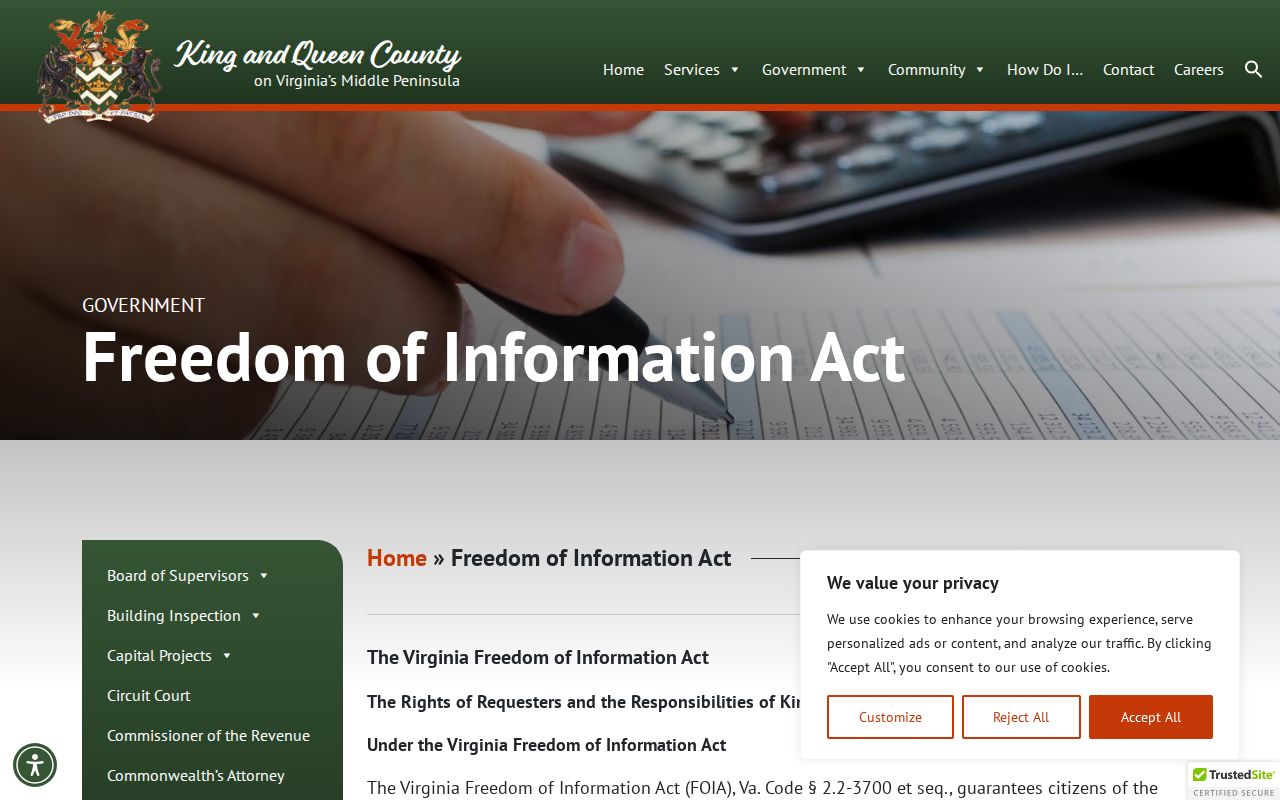
The county waives a request total of $12 or less and otherwise charges actual staff time plus copy or media cost. A response can supply records, cite grounds for withholding, report that records were not found, or invoke a lawful extension. The Sheriff creates local incident and arrest records, while VSP, DWR, and VMRC keep the reports they create. The Virginia DCJS biography of Sheriff William R. Balderson supplies the official image.
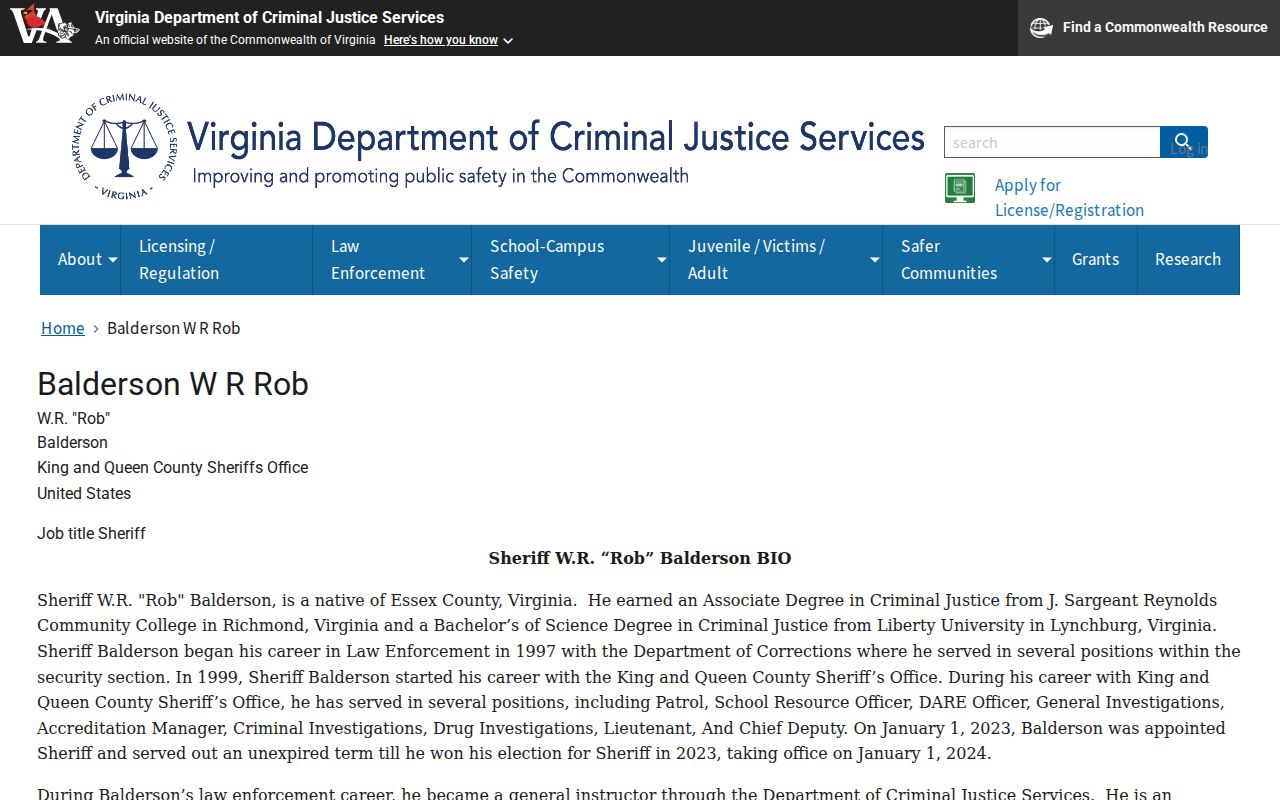
The biography confirms his service since 1999 and current elected role. The official county Sheriff's Office page supplies the next neutral capture.

The county page and published phone routes remain stable while the office's outbound domain resolves to a parked site. MPRSC runs a separate jail-record process and may seek a deposit when its estimate exceeds $200. Court files go to the appropriate clerk rather than through county FOIA.
Sealed, Expunged & Restricted
Virginia expungement under § 19.2-392.2 focuses on qualifying acquittals, nolle prosequi or other dismissals, mistaken identity, an innocence pardon, and a conviction vacated by writ. A King and Queen County petition begins in Circuit Court where the matter ended. Form CC-1473 identifies the charge, outcome, name at arrest, date of birth, arrest date, and arresting agency when available. The Commonwealth is a party.
Sealing under Chapter 23.2 is broader but does not erase all records. Major provisions took effect July 1, 2026. The chapter allows automatic relief for some lower-level events and petitions for specified convictions or deferred dismissals. Petition rules can include a seven-year misdemeanor period, a ten-year felony period, paid restitution, no disqualifying intervening crime, rehabilitation, and offense exclusions. Class 1 through 4 felonies, registry offenses, many violent or firearm offenses, and other listed matters remain excluded.
Juvenile cases and protected victim details are restricted apart from either remedy. After an order, review the local portal and one's own CCRE history. A lingering wrong entry should be taken to the agency that contributed it and then to CCRE.
Note: Sealing narrows ordinary access but does not promise destruction of every record held under an authorized government exception.
King and Queen County Warrant Records
No public King and Queen County warrant database, most-wanted list, or sheriff app was verified. Use the sheriff's operational number, 804-785-7400, plus the court that may have issued the process. Search an associated OCIS or GDC case, but never treat an empty search as proof that no warrant exists. Sealed, unserved, and juvenile process may not be public. A person checking their own status should call before appearing and learn the court, facility, and bond status.
Felony probation and parole are state-run. VADOC Gloucester District 5 serves King and Queen County from 6270 Professional Drive in Gloucester at 804-695-1693. The VADOC locator may show limited custody or supervision status, but not full conditions, officer notes, or the sentencing order. Virginia's Parole Board makes release decisions, while VADOC Community Corrections handles field supervision.
The official VADOC office directory identifies District 5's service area. For a final sentence or revocation outcome, confirm the supervision entry against the sentencing court's order.
Criminal Records by City in King and Queen County
King and Queen County has no incorporated cities or towns, so there are no city police departments, municipal courts, city booking facilities, or municipal records units to search. King and Queen Court House is a census-designated place, not a municipality. Residents of Newtown, Shacklefords, Walkerton, Mattaponi, Stevensville, and other unincorporated communities use the county sheriff, county courts, MPRSC, and Virginia systems.
County and state record channels replace municipal routes here. The county's adopted budget and the official Census incorporated-place roster both support that zero-city result.
Note: King and Queen Court House is a census-designated place, so it has no separate city records office or municipal court.
King and Queen County Criminal Archives
Government has occupied Courthouse Green since King and Queen County was formed in 1691. The historic district contains 17 buildings, including courthouse fabric from the Colonial era, an 1860s clerk's office and jail, Fairy Tavern, and later public buildings. Union troops burned the courthouse, clerk's office, and jail during the Civil War. Government buildings were rebuilt in 1866. This long and disrupted paper history is one reason an empty modern database should never be equated with the absence of an older surviving record.
The Virginia Department of Historic Resources Courthouse Green entry documents that history.
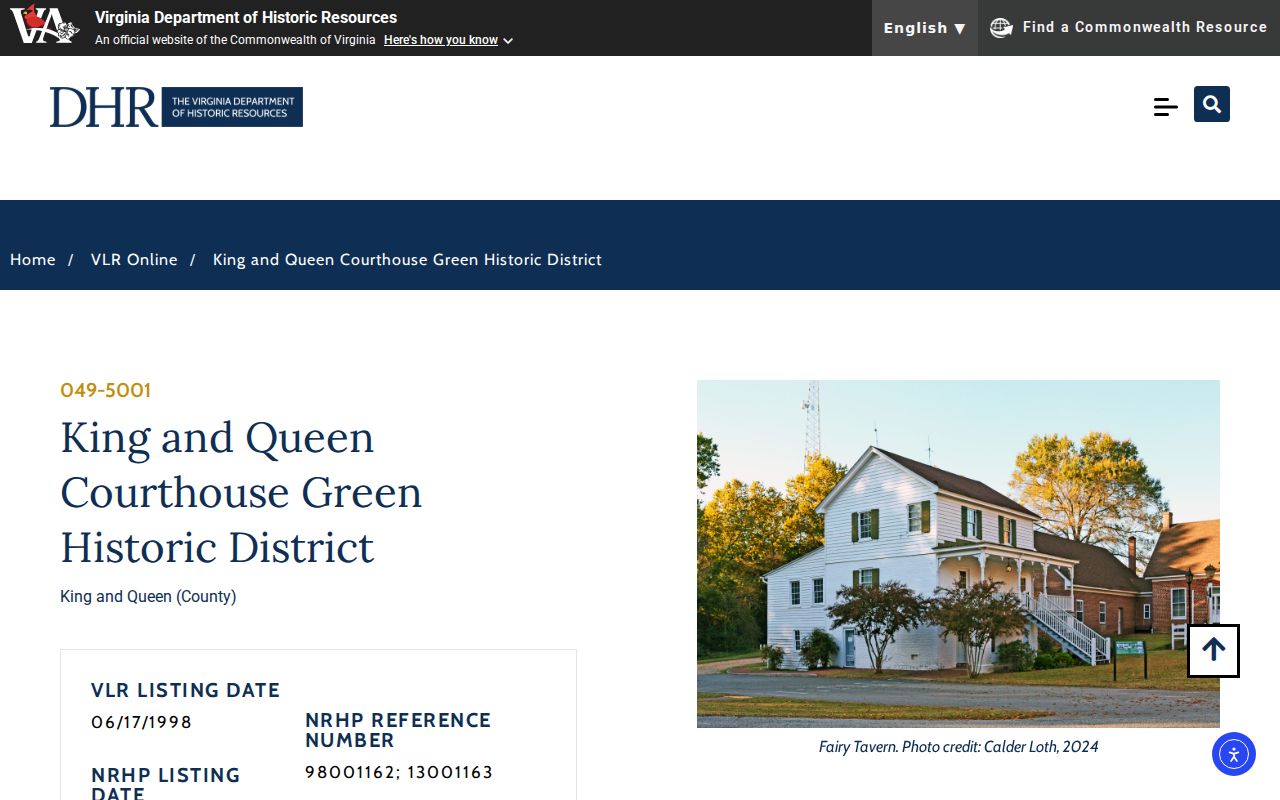
The photograph connects today's clerk counters to a government site used for more than three centuries.